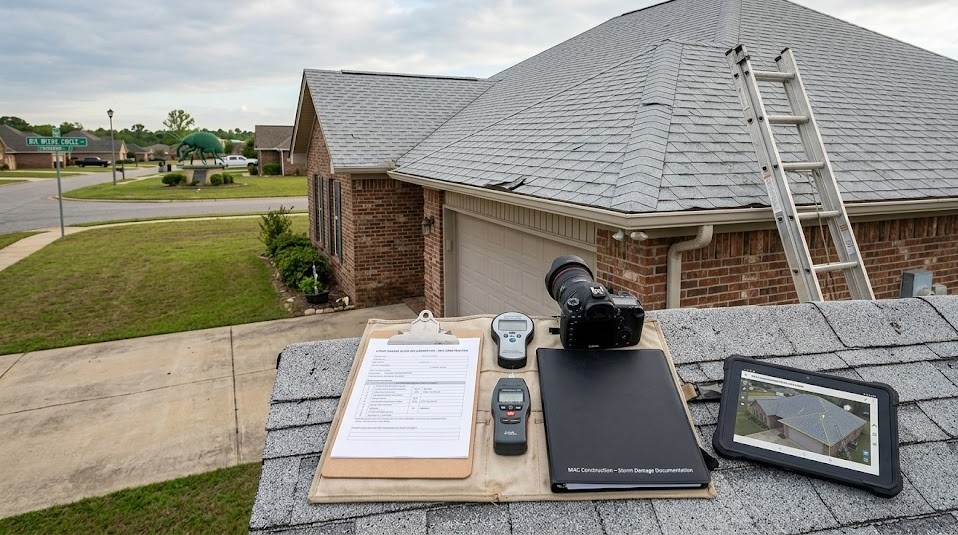
The clearest roof storm damage signs are granule loss in your gutters, missing or lifted shingles, dented roof vents or flashing, and water stains on interior ceilings. Wind and hail damage aren't always visible from the ground — a professional inspection is the only reliable way to confirm storm damage before it turns into a leak. MAC Construction offers free storm damage inspections across Dothan and the Wiregrass, with photo documentation for insurance claims.
Why Roof Storm Damage Signs Are Easy to Miss
After a bad storm rolls through Houston County, most homeowners check the obvious things — downed limbs, fence damage, anything visibly bent or broken. The roof usually gets a quick glance from the driveway and then gets forgotten, mostly because it looks fine from ground level. That's exactly the problem. Roof storm damage signs are rarely dramatic. Wind and hail tend to leave subtle marks first, and a roof that "looks fine" from the yard can still be compromised in ways that only show up as a leak months later, usually during the next heavy rain.
This matters more in the Wiregrass than in a lot of other places, simply because of how often severe weather actually passes through. Between spring severe thunderstorm season and the occasional hurricane remnant moving up from the Gulf, most Dothan homes will see several storms a year capable of causing at least some roof storm damage. Learning to recognize the early signs — rather than waiting for an obvious leak — is genuinely one of the most cost-effective habits a homeowner can build.
Stephen McDuffie, owner of MAC Construction and an Alabama-licensed contractor since 1991, has walked thousands of roofs after Wiregrass storms. His experience is consistent: the roofs that end up with the worst interior damage are almost always the ones the homeowner assumed were fine.
"By the time you see a stain on your ceiling, water has usually been getting in for weeks. The actual damage almost always happened during one specific storm — the homeowner just didn't know what to look for right after it."
Here are the seven roof storm damage signs worth checking after any significant wind or hail event — and which ones are safe to check yourself versus which ones genuinely need a professional set of eyes.
1. Granule Loss in Your Gutters
Asphalt shingles are coated with small mineral granules that protect the underlying material from UV damage and impact. Hail and heavy wind knock these granules loose. If you look in your gutters or at the base of your downspouts after a storm and see what looks like coarse, dark sand collecting there, that's granule loss — and it's one of the earliest, most reliable roof storm damage signs there is.
What to check (safe from the ground):
- Gutters and downspout outlets for loose granules after any hail or high-wind event
- Areas of your yard directly below roof valleys, where runoff concentrates
- Any noticeable color change or bald patches visible with binoculars from the ground
2. Missing or Torn Shingles
This is the most visible of all roof storm damage signs, but it's easy to miss if the missing shingles are on the back slope of the roof, facing away from the street. Wind gusts above roughly 60-70 mph — common in Wiregrass severe thunderstorms — can lift and tear shingles at the edges and ridge line first, since those areas take the most direct wind pressure.


Walk the full perimeter of your house after a storm and look up at every roof plane, not just the one visible from your front door. A missing shingle anywhere is worth a closer look, even a single one.
3. Exposed or Raised Nail Heads
When wind lifts a shingle even slightly without tearing it off completely, the nails underneath can back out or become exposed. From the ground this looks like small dark dots across the roof surface. It's subtle, but it's one of the more important roof storm damage signs because an exposed nail head is a direct path for water once rain starts hitting it at an angle.
4. Dented or Displaced Flashing
Flashing is the metal material sealing the joints around chimneys, roof vents, and skylights — and it's frequently the actual point of failure after a storm, even when the shingles nearby look completely fine. Hail dents flashing the same way it dents a car hood. Wind can lift and separate it at the seams.

Check any visible flashing around roof penetrations for dents, gaps, or a section that looks like it's pulled slightly away from the surface it's sealing.
5. Soft Spots or Sagging (Professional Check Only)
A soft spot underfoot, or a roofline that looks slightly uneven from a distance, usually means water has already gotten into the decking beneath the shingles. This is a more advanced stage of storm damage, and it's exactly why MAC Construction's free inspection includes walking the roof directly rather than just looking from a ladder.
6. Daylight Visible in the Attic
On a sunny day, go into your attic and turn off the lights. Any pinpoints of daylight coming through the roof deck are a direct sign of a puncture or gap. This is one of the few roof storm damage signs you can check yourself safely, and it's worth doing within a day or two of any major storm.
7. Ceiling Stains or Bubbling Paint
By the time a stain appears on an interior ceiling, water intrusion has usually been happening for a while — this is the last and most obvious of the roof storm damage signs, and the one that means the damage has already reached the point of an active problem rather than a preventable one.


Not Sure What You're Looking At?
MAC Construction offers free, in-person storm damage inspections across Dothan and the Wiregrass — with photo documentation you can hand directly to your insurance adjuster.
📞 Call 334-726-6401Request a Free Inspection
Written report. No pressure.
The Insurance Truth Most Homeowners Don't Know
Here's something worth knowing before you ever file a claim: insurance adjusters are trained to look for reasons a claim doesn't qualify, not just reasons it does. That's not a conspiracy — it's how the claims-review process is structured industry-wide. An adjuster who spends five minutes on a roof looking for the easiest explanation ("that's just wear and tear") isn't necessarily acting in bad faith. But it does mean the burden of proof sits more with the homeowner than most people expect.
The single biggest factor in whether a legitimate storm claim gets approved smoothly is documentation quality — specifically, whether there's clear photographic evidence tying the damage to a specific, dated storm event, ideally gathered before the adjuster's own visit rather than relying entirely on their assessment.
What Actually Strengthens a Storm Damage Claim
- Dated photos taken within days of the storm, not weeks later
- A written third-party inspection report from a licensed contractor, independent of the insurer's own adjuster
- Cross-referencing the storm date against the NOAA Storm Events Database, which independently confirms wind speed and hail size for that date in your county
- A clear, itemized scope of damage rather than a vague description
This is precisely why MAC Construction's free inspection produces a written report rather than just a verbal opinion — it's built to function as independent documentation, not just an internal note. Homeowners who get this documentation before their adjuster's visit are, in our 34 years of experience, considerably more likely to see a fair initial claim decision rather than needing to appeal one.
Timing, Insurance, and What to Do Next
Research from the Insurance Institute for Business & Home Safety (IBHS) confirms that roofs installed to modern wind-resistance standards suffer meaningfully less damage in the same storm than older, non-upgraded roofs — one reason MAC Construction discusses FORTIFIED roofing upgrades with homeowners after repeated storm damage.
If your insurer denies a claim you believe is legitimate, Alabama homeowners can file a complaint directly with the Alabama Department of Insurance.

One Local Note Worth Knowing
Unlike coastal Alabama, Dothan and Houston County aren't primarily a hurricane storm-surge risk — the National Weather Service office in Tallahassee tracks Houston County's real threat as severe thunderstorms and tornadoes. We cover the local storm pattern in detail, with real recorded events, in our companion article on Houston County's tornado and storm history.
Quick Action Checklist After Any Storm
- Photograph any visible damage from the ground — gutters, missing shingles, dented vents
- Check your attic for daylight within a day or two, if it's safe to do so
- Do not walk on the roof yourself, especially if it's wet
- Call for a free professional inspection before filing or skipping an insurance claim
- Keep all photos and the written inspection report together for your records
The Bottom Line on Roof Storm Damage Signs
None of these seven roof storm damage signs require special equipment to check for, aside from a pair of binoculars and a flashlight for the attic. What they do require is actually looking — within a few days of any significant storm, not months later when a ceiling stain finally forces the issue. It costs nothing to find out, and it costs considerably more to find out the hard way.
Roof Storm Damage — Your Questions Answered
Check your gutters for loose granules, walk the perimeter of your house looking up at every roof plane for missing shingles, and check your attic for visible daylight. These checks are safe from the ground. Anything suggesting soft spots, sagging, or damage you can't confirm from a safe vantage point should be left to a professional inspection.
No. Hail impact on asphalt shingles often shows up as granule loss or bruising rather than an obvious dent, especially on darker shingles where impact marks blend in visually. This is why granule buildup in gutters is one of the more reliable early roof storm damage signs — it's often visible even when the shingle itself looks intact.
Within a few days is ideal, both to catch any daylight-through-the-decking issues early and to support an insurance claim with a clear timeline tying the damage to a specific, documented storm event. MAC Construction offers free storm damage inspections and typically schedules within a day or two of a call.
Storm-related damage from wind or hail is commonly covered under standard Alabama homeowners policies, though coverage details, deductibles, and reporting windows vary by carrier. MAC Construction documents damage with dated photos to support your claim, and you can review your specific policy details or contact the Alabama Department of Insurance with coverage questions.
Storm damage tends to appear suddenly and in a specific pattern (concentrated on the side of the roof facing the wind, for example), while age-related wear develops gradually and evenly across the whole roof. A professional inspection can usually distinguish between the two, which matters for insurance purposes since gradual wear typically isn't covered.
Yes. MAC Construction's storm damage inspections carry no cost and no obligation — you receive a written report either way, which you're free to use for an insurance claim, a second opinion, or simply peace of mind.
Get a Free Storm Damage Inspection
Written report same visit · Stephen responds directly
What Wiregrass Homeowners Say
⭐ See All Reviews ↗"After the hail storm hit Enterprise, I called MAC Construction and they were at my house within 2 hours. They tarped everything that night and had a full written estimate by morning. The insurance claim process — they handled everything."
"MAC Construction replaced our entire roof after the storm last spring and we couldn't be happier. Stephen personally came out, walked us through every option, and the crew was done in one day."


Explore More Roofing Services & Locations
🔨 Storm & Repair Services — Dothan AL
📚 Guides & Resources
📍 Service Areas
🏢 MAC Construction
Don't Guess. Get It Checked.
Free in-person inspection, written report, and insurance documentation if you need it. Licensed since 1991.
AL License #30154 · 34+ Years · 4.9★ Google · Nextdoor Fave 2026